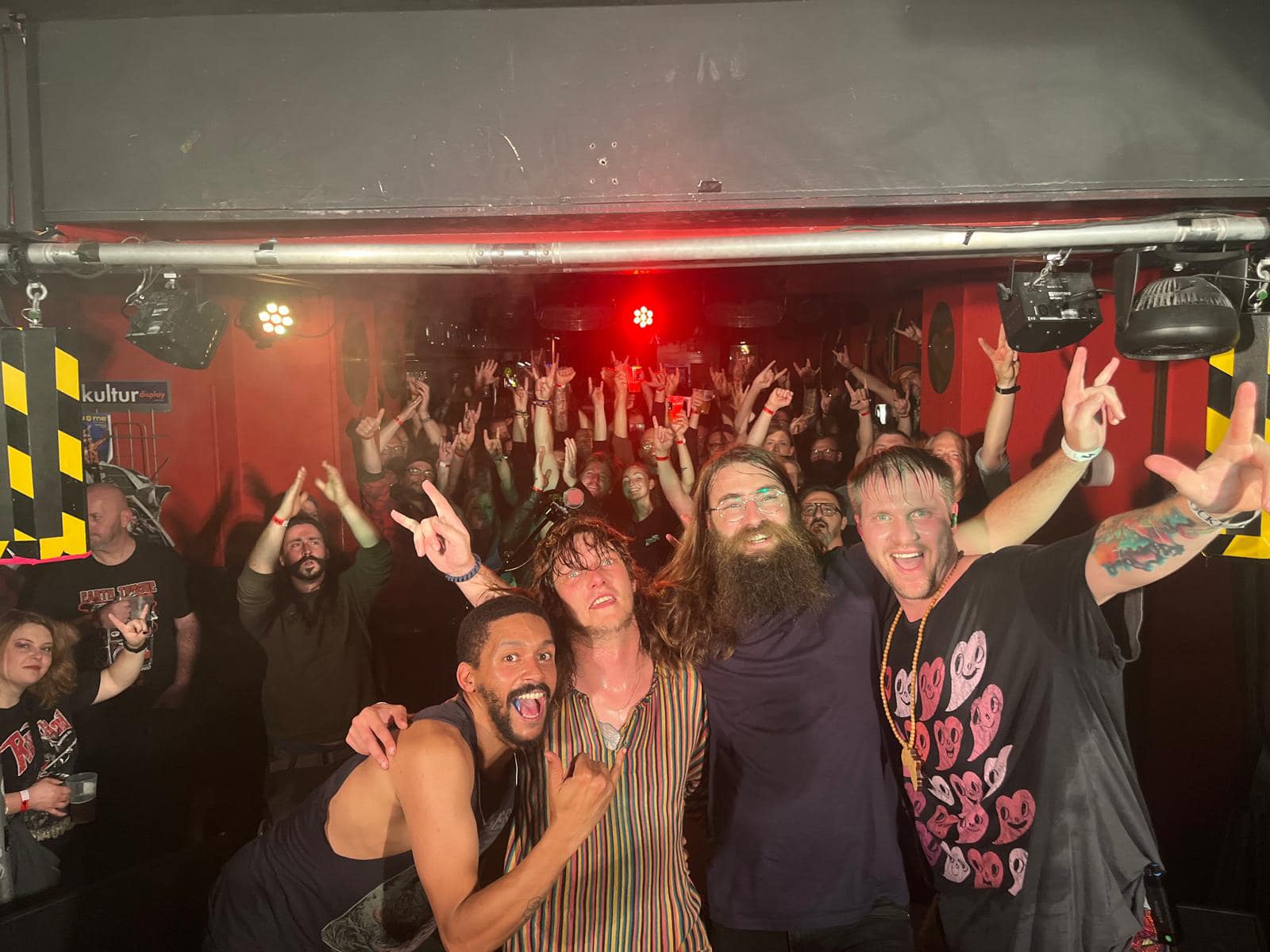
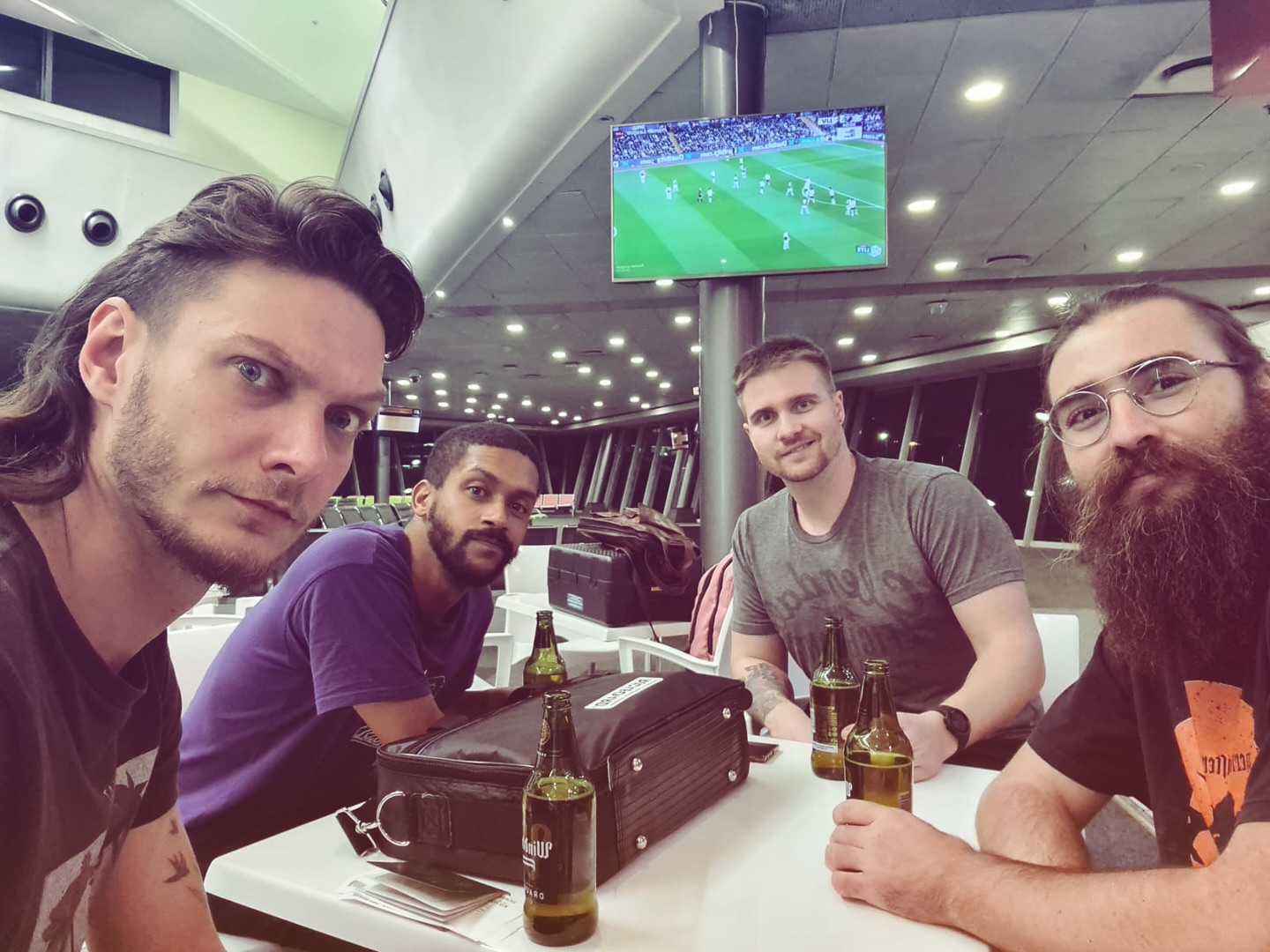
Spirit Mother release Thistle tomorrow, Sept. 4. The band’s third album overall behind 2024’s Trails (review here) and their 2020 debut, Cadets (review here), it marks their first release through Sound of Liberation Records and their first self-recorded full-length outing, captured as it was at the home studio of guitarist/vocalist Armand Lance and violinist/vocalist SJ Lance in the remote wilds of Eastern-ish Oregon. It also freatures a lineup restructured around those two, with Mia Rose (who was touring with them at least as early as 2024) also adding violin and vocals, Michael Fenris on bass and, in a fill-in capacity for the album, former Kadabra drummer Chase Howard.
Given all the change, Thistle is almost surprisingly cohesive across its 13-song/46-minute span, with a couple of interlude-type divergences in Jethro Tull‘s “Prelude” prefacing the cover “Locomotive Breath,” which they absolutely smoke, as well as the later originals “Ephemeral” and the rumble-in-the-distance closer “Transient,” and a collection of tracks around them that are purposeful and as heavy in mood and atmosphere as they are in tone, violin adding to the fullness of pieces like “Good Faith” and “Odetta,” an essential part of the dynamic that has taken shape in Spirit Mother‘s sound.
As there has been all along for Spirit Mother, there is a thunderstorm-at-night volatility to their Americana-noir-informed craft. “Dog Machine” makes a perfect opener for conveying to the listener that while Thistle feels in line with the band’s two prior LPs, the band is more aware of its own direction than it has yet been on record. This may be a side-effect of producing themselves, but it suits them very well as “Dog Machine” marries impulses from Scorpions and Stooges and surges into the first of the deep-mix washes Thistle has in store, also beginning an opening salvo that “Violent Son,” “Coat of Arms” and “Narrows” see through, marked by tight songwriting and variety in delivery.
Dark clouds change shape as they roll in, right? So do Spirit Mother songs, and in much the same way. “Violent Son” follows the leadoff with a shift, then “Coat of Arms” brings a lyrical “fuck ICE” energy to the party while continuing the momentum into “Narrows,” which was the album’s lead single for good reason in what it represents in scope and post-heavy-but-still-heavy vibery. The “Prelude” is a divergence, but a hypnotic 35 seconds ahead of “Locomotive Breath” is just enough, just a few measures of standalone violin, for the listener to regain enough consciousness to realize the strings-not-woodwinds take on the Tull classic, which is bombastic and fun in a way that Spirit Mother don’t always dare to be, while also being one of the brashest-sounding cuts on the record.
It is hardly the last crescendo Thistle has to offer. While clearly composed and refined as individual pieces, the album’s procession lends itself well to being taken in its entirety. Side A demonstrates this across the opening stretch and the manner in which “Locomotive Breath” blows it out, while side B expands around what the band has by-then established as the album’s intention. “Good Faith” is a consuming plunge still relatively clearheaded in a way that emphasizes the producer’s ear involved in this self-production as regards both the efficiency and professionalism of the presentation and the passion behind the execution of the songs, and the subsequent “Crux” is a sub-three-minute tempo kick with a crunchier fuzz in the guitar and an urgency that, again, hits at just the right time in the tracklisting.
The aforementioned “Ephemeral” follows as an acoustic-and-violin-led bridge to “Stranger, You Are,” which is also seemingly aware of itself as a highlight, preserving a sense of rawness in Armand‘s cough/grunt at 3:17 following the emphatic second chorus but growing in breadth as well as volume as it goes, while also laying out one of Thistle‘s more memorable hooks. From there, “Odetta” — named for Armand and SJ‘s daughter; another relatively recent advent — seems to pay homage to the chemicals produced in one’s body when one has a newborn child, which for sure are an underrated aspect of how the species has lasted as long as it has. It grows intense, as these things will, and so pairs well with the penultimate title-track, which feels like it’s been positioned to serve as the summation and apex for the whole album before it.
Here too, as the band rolls into the noisy climax of the song for which the LP is named, one can’t help but be struck by their clarity of purpose and the poise they maintain while also giving a sense of hitting hard. No doubt if they choose to continue helming their own recordings — note that Armand and Michael mixed and the master was by the esteemed John McBain — production aspect will be one more way in which they grow, but across Thistle, the self-produced aspect is a major way in which the album triumphs. I don’t know if either SJ or Armand are trained in audio production, but the record sure sounds like somebody is, and one wonders if, having built the studio, they might not plan on recording other bands there as well. Time will tell, but if you read “self-produced” as a dogwhistle for “unproduced,” that’s simply not what is happening in these songs. “Thistle” (with another cough/grunt preserved for good measure, plus intertwining backing vocals) wraps heavy and gives over to residual ethereality, which sets up the guitar-effects landscape of “Transient,” which may or may not be the strutting central riff of “Dog Whistle” slowed down, but caps on a suitably melancholic note, subdued but still looking out over some yellow-field expanse.
To-date, the story of Spirit Mother has been one of an emergent band with an individual point of view growing as songwriters and discovering what they want their music to be. Thistle doesn’t quite upend this, but it does add dimensionality to both their sound and their creative pursuit, finding a mature approach that doesn’t take away from the immediacy of some of what they’ve done before, but that casts it as part of an overarching evolution of perspective. I don’t know what the future will bring in terms of their take, and that in itself is refreshing and reassuring, but the moment in that evolution that they capture here is special and feels like the output of a group who have taken advantage of every learning opportunity they’ve had along the way. May they continue to do so.
Thistle premieres in its entirety below, followed by Euro tour dates (big fest run) from social media.
Please enjoy:
Spirit Mother, Thistle album premiere
We are STOKED to head back to Europe for our album release “Thistle Tour” THIS FALL 🥀 Thanks to @soundofliberation for putting it together, and there’s still more to come!!
25.9 Musiktheater Piano – Dortmund, DE 26.9 Into The Void Festival – Leeuwarden, NL 28.9 Kult61 – Hanau, DE 29.9 Cafe Glocksee – Hannover, DE 30.9 Forum – Bielefeld 1.10 Oetinger Villa – Darmstadt, DE 2.10 PsyKa Festival – Karlsruhe, DE 3.10 Kulturladen – Konstanz, DE 4.10 Up In Smoke Festival – Pratteln, CH 7.10 Channel Zero – Ljubljana, SI 8.10 Zauberberg – Passat, DE 9.10 MUZ – Nürnberg, DE 10.10 Keep It Low Festival – Munich, DE 11.10 Bandhaus – Erfurt, DE 13.10 Neue Zukunft – Berlin, DE 15.10 1000 Fryd – Aalborg, DK 16.10 Schaubude – Kiel, DE 17.10 DesertFest Belgium – Liège, BE
SPIRIT MOTHER is: Armand Lance – Guitar, Vocals SJ Lance – Violin, Vocals Michael Fenris – Bass Mia Rose – Violin, Vocals
Posted in Whathaveyou on July 6th, 2026 by JJ Koczan
“Narrows,” the first single from the upcoming third Spirit Mother LP, Thistle, carries a characteristic sense of expansive, grounded melancholy that still reminds of waving grass and things vague on the horizon. Also it’s at the bottom of this post, which was the original end of that sentence before things went all gritty-melody, full-tone, gorgeous and sad. The band, now located in Burns, Oregon, after leaving Los Angeles as I’m told one might do, signed with Sound of Liberation Records earlier this year for the Sept. 4 release, and now the band have announced the tour that will see them supporting the album in Europe this Fall.
Spirit Mother were previously announced for Up in Smoke, Keep it Low and others, but the tour gives the full scope of where they’ll be and when, including a few TBAs that, if they’re not festivals, you should reach out and put them up for a show. I promise I’ll bug whoever needs bugging about bringing them to northern New Jersey when they’re thinking about heading east, but for now, this one’s on you. Help if you can.
Dates and links follow:
We are STOKED to head back to Europe for our album release “Thistle Tour” THIS FALL 🥀 Thanks to @soundofliberation for putting it together, and there’s still more to come!!
25.9 Piano Dortmund DE 26.9 Into The Void Festival Leeuwarden, NL 27.9 TBA 28.9 Kult61 Hanau DE 29.9 Cafe Glocksee Hannover DE 30.9 Forum Bielefeld DE 1.10 TBA 2.10 Psyka Festival Karlsruhe DE 3.10 Velvet Two Stripes Konstanz DE 4.10 Up in Smoke Festival Pratteln CH 6.10 TBA 7.10 Channel Zero Ljubljana SI 8.10 Zauberberg Passau DE 9.10 MUZ Nürnberg DE 10.10 Keep it Low München DE 11.10 Bndhaus Erfurt DE 13.10 Neue Zukunft Berlin DE 14.10 TBA 15.10 1000Fryd Aalborg DK 16.10 Schaubude Kiel DE 17.10 TBA 18.10 TBA
S/o @dave.nyhc for the killer poster
—
Following the release of their sophomore album Trails, the band spent 2024 and 2025 relentlessly touring throughout the United States and Europe, including appearances at Desertfest New York, Levitation Festival, Rock Im Wald, Blue Moon Festival, Berg Herzberg, Festival Kult and Hoflärm. Along the way, they have shared stages with acclaimed acts such as All Them Witches, Graveyard, King Buffalo, Weedeater, Acid King, Melvins, Blackwater Holylight and LA Witch.
Returning home after extensive touring, the band dedicated themselves to writing and recording Thistle entirely on their own terms. The result is an album that captures both the isolation and beauty of their surroundings while pushing SPIRIT MOTHER’s unique blend of heavy rock, Americana and psychedelic influences further than ever before.
SPIRIT MOTHER is: Armand Lance – Guitar, Vocals SJ Lance – Violin, Vocals Michael Fenris – Bass Mia Rose – Violin, Vocals
Posted in Whathaveyou on June 10th, 2026 by JJ Koczan
There was an Instagram video of Spirit Mother mixing their new album, Thistle, with guitarist/vocalist Armand Lance holding his and violinist/vocalist SJ Lance‘s new baby in his arms, and I bet that’s gonna be a trip for him to go back and watch in a few years. Congrats to them on said baby, by the way, and also on getting an album done alongside keeping alive a little pile of human goo. Also they moved to Oregon. I guess it’s been a busy time since they put out Fall 2024’s Trails (review here).
Their third LP overall, Thistle I believe will mark their first outing with second violinist/vocalist Mia Rose, as well as bassist Michael Fenris. Former Kadabra drummer Chase Howard played on the album, I’m pretty sure, but isn’t listed in the lineup below or in the photo above, which makes me think it was kind of a fill-in capacity. With the baby, I’m curious how much touring Spirit Mother will do to support Thistle, but I’m excited for the record anyhow, considering how rich this band’s sound already was in their last incarnation. Hopefully I’ll have more on it between now and September.
From the PR wire:
SPIRIT MOTHER Announce New Studio Album “Thistle”; Out September 4, 2026 Via Sound Of Liberation Records
US heavy rock outfit SPIRIT MOTHER have announced the release of their third studio album, Thistle, due out on September 4, 2026 via Sound Of Liberation Records. Written, self-recorded and self-produced in the creaking attic of Armand and SJ Lance’s century-old cabin in the high desert of Burns, Oregon, the album captures the spirit of the remote landscape the band now calls home.
A direct reflection of life in Eastern Oregon’s vast and windswept outback, Thistle sees SPIRIT MOTHER fully realizing the sonic direction hinted at on its acclaimed predecessor Trails. Combining the band’s signature dynamic intensity, fuzz-drenched heaviness and grunge-infused rock with a haunting sense of Americana melancholy, the album offers their most immersive and personal work to date. From blistering desert horizons and abandoned ghost towns to the sounds of rattlesnakes, wild horses and open prairie, Thistle translates the environment surrounding the band into a rich and cinematic musical experience.
Further details, including the album’s first single and pre-order launch, will be revealed in the coming weeks.
Thistle Track Listing: 1. Dog Machine 2. Violent Son 3. Coat Of Arms 4. Narrows 5. Prelude 6. Locomotive Breath 7. Good Faith 8. Crux 9. Ephemeral 10. Stranger, You Are 11. Odetta 12. Thistle 13. Transient
Originally formed in Long Beach, California and now based in the rural Pacific Northwest, SPIRIT MOTHER have carved out a distinctive place within the modern heavy rock landscape. Their sound blends folk-informed songwriting, atmospheric strings, haunting vocal harmonies and crushing rock dynamics into a style that is both expansive and deeply emotional.
Following the release of their sophomore album Trails, the band spent 2024 and 2025 relentlessly touring throughout the United States and Europe, including appearances at Desertfest New York, Levitation Festival, Rock Im Wald, Blue Moon Festival, Berg Herzberg, Festival Kult and Hoflärm. Along the way, they have shared stages with acclaimed acts such as All Them Witches, Graveyard, King Buffalo, Weedeater, Acid King, Melvins, Blackwater Holylight and LA Witch.
Returning home after extensive touring, the band dedicated themselves to writing and recording Thistle entirely on their own terms. The result is an album that captures both the isolation and beauty of their surroundings while pushing SPIRIT MOTHER’s unique blend of heavy rock, Americana and psychedelic influences further than ever before.
SPIRIT MOTHER is: Armand Lance – Guitar, Vocals SJ Lance – Violin, Vocals Michael Fenris – Bass Mia Rose – Violin, Vocals
Posted in Features on March 6th, 2025 by JJ Koczan
In my defense, there was a lot to talk about with Matte Vandeven. Between 2025 being the 20th anniversary of the booking agency he founded, Sound of Liberation, and the return to the stage of his band, My Sleeping Karma, after suffering the loss of drummer Steffen Weigand in 2023, the near-unmatched impact Vandeven has had on the European heavy underground particularly with the emergence of a heavyfest culture he’s helped foster over the last decade and a half through close involvement with events like Desertfest Berlin, Up in Smoke, Keep it Low (celebrating its 10th edition this year), Blue Moon Festival, Lazy Bones Festival, Desertfest Belgium and others, the growth in the last few years of Sound ofLiberation‘s label wing, SOL Records, and generally wanting to pick his brain about bands, what he listens for in a new artist, and so on? You can see why it might be a lengthy interview.
Vandeven was kind enough to indulge this interrogation, and that is appreciated. Later this month, Sound of Liberation will begin a series of all-dayer events — there are more to come — scattered throughout this year in Germany. The first two announced were the SOL Sonic Ride in Cologne, the SOL Psych Out in Karlsruhe, and for June, already a second Sonic Ride has been announced in Wiesbaden. The lineups of course pull from Sound of Liberation‘s roster of talent: Colour Haze, 1000mods, Slomosa, Greenleaf, Valley of the Sun, King Buffalo, Brant Bjork, Gnome, Daevar, Daily Thompson, Kant, Earth Tongue and Lucid Void spread across the three-so-far lineups. Posters are included along with the Q&A that follows here.
I guess there’s a fair amount of assumption here that you know who Matte is and what he does, but for over 20 years he’s played bass in My Sleeping Karma — and was in The Great Escape before that — and headed up one of underground Europe’s broadest-reaching and most-impactful booking concerns. He is, in short, a professional, and someone who has helped shape heavy rock and the various associated microgenres as they are today. We’ve spoken before, so I wouldn’t say I was nervous to talk to him, exactly — no more so than when talking to humans at all — but this is somebody whose work and passion I deeply respect. It was great to catch up with him.
Congrats to SOL on 20 years, I can’t friggin’ wait to see My Sleeping Karma at Freak Valley this June, thanks to Matte for taking the time and thanks to you for reading. Q&A has been edited for clarity. Please enjoy:
—
—
Happy 20th! I know, of course, the 15th anniversary celebration was a giant wreck because covid, although eventually it all worked out right. But I assume you’re hoping for a much smoother go on the SOL Sonic Rides. Tell me about 20 years of Sound of Liberation, what that means for you.
First of all, JJ, thanks for your time. It’s a pleasure to meet you here, and hopefully, soon in person. 20 years of Sound of Liberation. What can I say? Like everybody said, like, “Whoops. That was 20 years ago already?” Time’s passing by so quickly. So yeah. Hey, you named it. We wanted to celebrate the 15th. It was crashed by the covid pandemic, and we are just being thankful we have the chance to hopefully celebrate throughout the year on all our events, and see all the lovely people again which supported us over the last 20 years. At the moment, it’s just a feeling of being thankful to still do what what we are doing. And continuing hopefully, another 20 years of doing what we love.
I think it says something that the way you’re celebrating your 20th anniversary is basically by making a bunch more work for yourself. You have the Sonic Rides in March and in June. Is there more coming?
Yeah. See, here’s the thing. We’re doing quite a bunch of events throughout the years, with Keep it Low Festival, and also there’s Desertfest Berlin, and Up in Smoke in Switzerland. But, it turns out that we still have 40-50 bands on our booking roster, and we are trying to get as many as possible of them invited to events, and it turned out that the March period was fine for a few bands which are touring like Greenleaf around.
And yeah, Cologne was the easy city to reach, and we got the chance to gather the first 10 bands there, and in the summer period the King Buffalo dudes are around. Brother Brant Bjork is around, and so on. So we we added just another one in a beautiful location.
And we are not planning another three or four more, because the fall season is already busy with almost a festival every October weekend. So yeah, I think that’s fine. But let’s see how it goes. You know, we are not always planning things from a very, very long stretch. Sometimes it turns out that you have a bunch of bands around on the same weekend or the same date because of touring, and if we can create a small event out of it, why not?
I imagine over the course of 20 years you’ve seen a lot of venues come and go, a lot of bands come and go, but I imagine between SOL staff, bands and venues, you’ve built significant relationships along the way. Can you talk to me about developing those relationships and how that has let you extend your reach with Sound of Liberation?
I mean in 20 years like you said so many paths are crossing again, and when I think really back to the pioneer pioneer days, or whatever you want to call it, I have to name Colour Haze from Munich because Stefan is, in let’s say this underground music niche stoner heavy rock for so long as well with his Elektrohasch label and Colour Haze celebrating 30 years this year. I think Stefan with his label, and also starting to do first let’s say heavy rock happenings, back then.
In the year 2000, Swamp Room Mania or whatever it was called back then in Munich, there was already built a strong relationship. I was able to book then the first Colour Haze tours, and they are still on our roster now, and they are hitting the road [this] Friday on a bigger European tour.
That was 20 years ago, when we started searching for places where small German underground bands could find a spot to rock, and sometimes it was in just in side rooms of of bars, and you needed to wait until the sports event on the TV is over and you have built and even brought your own P.A. in the in the van. And then there was like eight drunken people there and listening to music they didn’t understand, so no.
That’s why I want to name color is because among many other bands. It’s a close relationship with Stefan for many years and understood how difficult it was for him also to press vinyls and release music only a bunch of people seem interested in so.
So you go from putting Colour in the side room at the bar to, with the festivals you mentioned, having a bit of an empire going. As you said, it’s every October weekend there’s a SOL-affiliated festival.
It’s every weekend in October, because you have up and you have Up in Smoke. You have Keep it Low.
There’s Desertfest Belgium.
Lazy Bones in Hamburg. Yeah, to look it, it sounds like an empire and building up something big. But I really have to say, like, it came organically, if we wanna use that word, and it would have not been possible without a great team I have behind me, and also the partnerships we are in, because honestly, I was not running around and calling throughout Germany to see who was interested to do a stoner rock festival in their venues, it’s the venues we are working with.
Or it’s the promoters, like in Switzerland. They have been in the market for a long time, and they were interested. Once we came around with club shows, they said, “Wow, this was big fun. Can we have more of those, or is there not a chance to do a one-day event or something like this?” So it was not only pushed by Sound of Liberation, or by me saying “I have something, and let’s make something big out of it.” We started all these events super small. I think, on the first Up in Smoke Festivals, maybe 300, 400 people in that 1,000 people room.
Keep it Low was for many years in the beloved place of the Feierwerk in Munich, which is more, two rooms with 400-450 capacity. But it was growing in the last couple of years so much that we needed for production terms, also to use the bigger venue in Munich, so what I want to say is,
we started something small as a really, yeah, an event for us, without the meaning of a financial profit, or like a building up something super big. It was more like it came over the years. And all these events are now like 10 years old already. So it’s nice that people still coming and are interested in. And yeah.
For example, Lazy Bones is a nice thing, because we we started it right after the pandemic as a two-day event in the center of Hamburg in summertime. And we were thinking like, “Wow, for sure, after the pandemic everybody wants to see live concerts.” In the end we had a massive lineup really like with I don’t know, Witch and King Buffalo, and 1000mods and Colour Haze and My Sleeping Karma and and and… and I think we had one day 250, and one day 280 people only for a lineup, which would probably draw 1,000 people. The people who were there like they were saying, “We are ashamed for Hamburg, we don’t know what’s happened.” And we said, “Okay, let’s give it another try.” I mean, it’s Hamburg. It’s a great city. And a year later it was working out much better already.
In the last 20 years, internet word of mouth, and now algorithms, have changed the way people encounter new music. How has that affected what you do? So much of promotion happens online now.
Yeah, I mean, you know it, JJ, and the people listening to our words now, they know it as well how fast the wheel is turning nowadays, and I would be lying if I would say, we don’t push the social medias. Of course we need to push it, because yeah, it’s part of the business now, like on every other business as well. You need to have a social media presence to be noticed.
Maybe the good thing is, when we started there wasn’t so much chance of social media and we were used to like sending our own posters and sending our own flyers, and hanging the posters in our favorite bars and rock bars and venues, and spreading the flyers in the street. So we also understood how.
Let’s say, how is it called mouth to mouth propaganda works. And yeah. So I think that’s good and helps to still have this knowledge. And yeah, to have built up a scene already before all the say social media took it mostly over nowadays. But we are still getting normal emails.
So also, when you are standing at the merch booth and talk with fans, especially a bit older ones, they are saying, like, you know, “we don’t use the Instagram. Send us an email or a newsletter. We prefer that because we are not Instagramers, Facebookers, Tiktokers, or whatever.”
In general terms for Sound of Liberation, what are you looking for from a band? And I don’t necessarily mean something specific, sound-wise. But is there something in terms of attitude or work ethic, or even musically, that lets someone stand out?
That’s a good question. That’s the that’s the tricky one, I mean. There’s so much good music out there, for millions of fans. Only a few like getting the attention, and many more deserve the attention as well.
Sometimes it’s not only in the music. Sometimes it’s not only in the attitude of the band, it’s maybe a mix of both. But let’s take an example: Slomosa, which are pretty much kicking off worldwide in the heavy rock scene. We discovered the band on a Spotify playlist. We loved this, let’s say, ‘hit record’ debut record. And I think that’s maybe very first point, they had a strong, very first record, like, let’s say, with hits on it, or music that catches you right away where I think like, “oh, what is this band? Wow! That that song sticks in my head I have to check, is there more?” And then finding out that the band is willing to put a lot of effort in their music and also in touring. So we started to bring them on live concert, and they develop themselves from a very good live band already into a live machine like super-good, super-good live playing band. So all in all, the complete package worked pretty great — like the album was good, they were on the road when they were playing shows. It went very fast that they were able to take the next steps. Of course we could help with booking expertise and putting them maybe on the right spots on festivals or support tours.
But I just wanted to name Slomosa, because it was very quick and was a band which came out of nothing, so to say, so to sum it up, every band has the chance. There was no demo center on. There was no management which pushed, or music industry which pushed and said, “this is the next big thing.” There were some good songs on Spotify. Maybe on the right playlist. So I don’t know how that worked, and in the end it led to a very fast progression of the band.
Slomosa kind of came out of the gate ready though. With most bands, they gel over the first few records, depending on the band. Some get there, some don’t. What do you do with a band who destroys live and the record’s not there? How involved with your bands can you get? Or have you gotten?
It really depends from band to band. If we are asked for our opinion, we give the opinion, but we don’t point out and say like, “Hey, you should do this.” It’s art, and everybody has their own perspective on it. But now, in viewing it, sometimes we wish some bands would maybe ask a little bit more around what they could do better in terms of maybe songwriting or structures, getting some more advices, not from me, but maybe in general, before they put out a release to get the maximum out of it. But yeah, it really depends from band to band. I mean only a few bands in our genre are putting really all their efforts or dedicating their life just to this band, to reach the next steps very fast, to be maybe even be able to live from the music. That’s already difficult.
Let’s say we are working with a lot of semi-professional bands in our genre. The people have normal day jobs and have music as a hobby and the free time they have, they’re using it for touring or recording. And yeah. So the advice we could give is really individual to the artist, on the path they are choosing for their music. But If the right demo comes, and the right attitude is there and the band really wants it, I think, as a booking agency in our genre, of course, we are able to help and to get the band faster on some bigger stages, because that’s still the most important. The more people you can have in front of stage, and you can convince about your music, the better the chance to step up the ladder a bit a bit faster.
You mentioned King Buffalo before. That’s an established band you’re bringing in. Obviously, that’s a different process from plucking a new band starting out. What are some of the considerations there?
King Buffalo is also a good example. They are a super-hardworking band. It’s work like it’s really a machine, like so much output they had during the pandemic and after and all with great quality. And that’s what I meant before, like these are guys who, like dedicated their lives to their band and they love touring. And all the time you see the list of touring in the States over here in in Europe, you think like so wow! Are they having a home, or are they just on the road?
King Buffalo has reached let’s say, a certain level, where it’s easier for us to book, because they have proved they are super live band, and they have the great albums, and they have a good following. So they are getting the chance to go bigger and bigger in the in the venues. Now they can play some bigger club shows already in in bigger venues, which is very, very good for the time the band is around, because they are still a still a young band, and they have a lot more to come for them if they continue like that. I have no doubt on that.
Is it harder now for a US Band to go to Europe, or for a European band to go to the US?
I think it’s still more difficult for a European band to go to the US. With all the visas you need and a bit harder conditions than we have over here in Europe. I think it’s still easy to plan your European tour, and of course you need some paperwork, but not that much. And, as you know, JJ, we have a there’s a good infrastructure also out here with van rentals and backlines and the driving distances are shorter, maybe. The hospitality is a bit better. No offense.
I get it. You might get a meal or a place to stay in Europe. You probably don’t get a meal in the US. Yes.
It’s still easier for the bands from the US touring in Europe than vice versa.
No, my country totally hates culture. It’s an ironic part of our culture. To shift gears entirely, My Sleeping Karma in December came back to the stage for your first shows since Steffen passed, and I cannot imagine how emotional this was for you. This first gig in particular. Can you talk a little bit about bringing the band back and what that’s been like? You have a busy year coming up at this point, and I keep seeing more added.
My Sleeping Karma is also 20 years old, so it’s big part of our lives. Seppi, Norman, and me, who are still around and able to now continue again with My Sleeping Karma, which was a very tough and very emotional and very sensitive decision. We have been the same lineup for more than 20 years. The band is years 20 old, but we had other projects before we were playing together. And we were really questioning and doubting if if we can continue with Sleeping Karma or bring this back again with a with a live show.
It took a while, and at one point our light engineer, who was traveling with us for years, Andre came up and asked Seppi and me if it’s possible just to jam just for like the sake of a jam. And maybe he had the feeling these guys need to have guitars in the hand again, and need to just be together again, to be able to even think about continuing, because we had not met up for a year. Nobody wanted to go in in the rehearsal room. Nobody wanted to, I don’t know, even talk about the band and so we did this jam and it felt good. Maybe it just felt good to hear the sound again of our band, or feel the vibe of the of the band members like just doing their thing what we have started long time ago.
And so we left on these meetings a bit with an open end and said, “Hey, okay, if the time fits like we jam another time and a few months later there was the time again to meet up and to jam. And Andre came prepared like with five songs really he worked on. He didn’t really say anything about it and we played Sleeping Karma songs, and it sounded alright.
Over the next couple of weeks and months, it developed more and more the idea of like, “Hey! What do you think? Should we do it again? How is it feeling for you like a lot of forward and backward until we…” and I, I really have to say, the fans and friends, and also the families, were a big, big part of this, encouraging us saying, like, “Hey guys, please, life needs to go on. And you guys are there and don’t stop making music. Please go on with that band. It means a lot to us.” And we got so many messages and so much feedback and we decided to continue with Sleeping Karma.
And we really did not know until that first concert in Munich on Colour Haze’s 30th birthday, two days before our hometown show in Aschaffenburg, if it would work, how it would feel the first time on stage in front of people. And then also with bands we’ve known for a long time, it all felt super alright, I think. Very emotional concerts, but also with some magic in which I cannot describe.
Everybody who plays in bands and knows I’m not talking about the groove or the flow like it was more This grown energy, which was there again, and not just created by the moment but created from us the band members over years, and so half of our life and everything was somehow in, and it was somehow clear: We are doing the right thing. It was clear not because people gave a lot of applause or wanted encores. But it was there the full moment, the full thing, why we started the band. And yeah, I hope we have Steffen’s blessing for that to continue.
I would imagine so. I have never seen My Sleeping Karma, and I don’t know if you know this, but I’ve been a fan of your band since your first record. So 20 years.
Yeah, we never made it to the US.
No, no, it’s not on you. It’s on me. But I this year is the year I’m lined up to see the band. Freak Valley’s on the calendar. I have been looking forward to it since that announcement.
We’re looking forward to that show as well at Freak Valley Festival. It’s always also like a homecoming. Good people there and it will hopefully be a great night, another emotional one.
There will be more concerts before this. I don’t know the number, but it’s not really a lot. We are not able to go on bigger tours now, or we didn’t want them. It’s like more still, finding our place again.
One more topic jump. The label. You gotta tell me about SOL Records. I feel like, okay, SOL Records happens a few years ago. I get the email about it. My response was like, “Well, yeah, duh.”
In 2005 we started Sound of Liberation and a few months later I had also founded that record label but never had the time to take care of it. At that time I was the one man army and had too much going on with the booking agency.
But yeah SOL Records also grew organically. My beloved word, organically growing, haha. But it is really like that. And so pretty much what happened, the pandemic came — no more live music. Everything crashed down, no more touring. We were sitting on a bunch of merch like already produced for festivals, already produced for touring bands. A lot of leftover back then from years of music business. So we said, “Okay, only chance. We can still go on doing things we love. Let’s build up a webshop.” With the help of our former employee “Stef” we launched the shop and afterwards we were thinking , “Why are we not releasing at least music we like without a small without, like, you know, searching for the biggest bands right away, and starting just with people we know, and friends and underground music. Our employee, Jakob (26 years old) is taking care of the label now.
He was working in a record store, and he came to our team and he said, “Hey, I really I really love this all. I love the bands. I love the sound. If I would have the chance to work a few hours on the mail order, and maybe on the label at one day.” And so we said like, “Hey, so why not? If we have somebody who’s like really focused and dedicated on this. Who wants to do it.” More or less, it’s in Jakob’s hands.
So then one thing came to another, we had the chance to re-release Trails & Passes from Greenleaf. You know the rights were free, and they gave us the chance, and also Monkey3’s 39 Laps record. And then we did our own releases. And all of a sudden I don’t know what one and a half years we had six or seven releases. We didn’t understand how fast that goes. We were a bit lucky also with pressing plants, because, as you remember, in the pandemic it was a wreck. Six to nine months until you were able to get a pressing plant or the finished product. And we had good luck. We were able to get four releases or something right after the pandemic.
And now same here with the label. We are not pushing it hard heart and signing bands, and, you know, like releases releases releases. It’s more like, Hey, what do we have the capacity for? Which music fits us right? And yeah, then. So no big business plans behind. No, not the not going for the giant corporate. Just needed to be done.
My favorite thing about it is it’s young bands. You mentioned the reissues and stuff, too, but you’re signing new bands.
Like guys from Ruff Majik. You have heard their music, or maybe you’re familiar with the band from South Africa, loving totally what they are. Yeah, and those guys have so much energy and put so much effort in and reached out more or less for help. And we booked the tour. So we made a plan and said, like, “Hey, why aren’t we are not doing things the right way? Let’s have a release ready next time when you are touring.”
Because do you remember how often that goes like, hey, we go into album-release tour, and then all of a sudden, sorry, album is delayed for two or three months, so we are trying to avoid that a little bit with not a business plan, but with a better structure and long-term planning. And I think that also helps a lot.
I think that’s also super important for young bands to have a bit of a timeline. I know it’s super difficult to think “Oh, we are now in February, what are we doing [next] winter? But every bigger or known band already knows what they are doing [next] winter, either recording or touring. So that’s also a big part of the growing process of a band, having a good plan structure and a good timeline for themselves to understand, “these are our goals we want to reach,” and also transporting these ideas to their partners or business partners, like record labels and booking agencies in order to get the maximum out of it.
Because, how often has the promo for the record come after once the tour was done, band was back at home? “So, hey, I just discovered this band. Let’s see when they are coming on tour. Oh, shit! They were here two months ago.”
If we can help with that with our expertise, that also helps. But back to the point. Still, we love what we are doing, and we are still infected by sound. And the music is the most important. And if a demo hits us or a band hits us, and then we yeah, then it’s not easy to say, no, we want to help because we love the album so much, or like the band, so much. So. Yeah.
So we released the Ruff Majik record, and what I like about it is it was not no more the typical, let’s say, Black Sabbath stoner rock, like there was so much different kind of rock music in, and so much freshness in that record that we decided like, “Hey, we wanna we want to release that one.” Not only we want to help Johni [Holiday] because they were in the EU touring, and nobody gets rich selling vinyls or CDs.
And I guess the touring helps them a lot, you know, being around a lot seeing other bands sharing the stages. Playing a lot live is the most important. I know it’s a difficult thing, “How do we get on the stage?” It’s always the same thing. Do you have a good demo? But you have no chance to play live. Difficult. It stays difficult, but there’s a big chance out now with the social media and the web like to gain new fans, friends, clients, however, you want to call it like it was never, maybe never so hard, but also never so easy to be recognized like this.
My Sleeping Karma, “Ephedra” live at Colour Haze’s 30th Anniversary, Dec. 28, 2024
Posted in Reviews on October 17th, 2024 by JJ Koczan
Writing this intro from a bench near the playground at my daughter’s grade school. It was different equipment at the time — made of unrecycled tires, because it was the ’80s — but I used to play here when I was her age too. The Pecan’s day ended about 10 minutes ago and after-school go-time has become part of the routine when we don’t have to be elsewhere. It’s chilly today — I have my hat on for the first time since winter, but if I was more used to the cold, I wouldn’t need it. If it was April, I’d be in shorts celebrating the arrival of spring. All depends on which way the planet is tipped, I guess.
Pretty sure I mentioned this at some point, but in part because the Quarterly Review is going well, I’m adding an 11th day. That brings it up to 110 releases, which, frankly, is just stupid. I don’t really have a reason I’m doing any of it except that I am. I feel the same about a lot of this lately.
As happens with any decent QR more than a week long, I’m behind on news. I don’t really have anything to say about a new Dax Riggs song or an Acid Bath reunion without any context, and I’m not cool enough to be in the know on any of it, but Roadburn has done a lineup announcement that I’d like to post and Uncle Acid announced a US tour, so there’s stuff to catch up on. Tuesday and on, I suppose. Good thing the internet exists or disseminating any of this information might have any stakes to it whatsoever.
Quarterly Review #81-90:
—
Castle, Evil Remains
Hammerheart Records steps forth to issue the masterful metallurgy of Castle‘s Evil Remains. The duo of bassist/vocalist Liz Blackwell and guitarist/vocalist Mat Davis work with drummer Mike Cotton on the 37-minute eight-tracker that’s the first new Castle LP since 2018’s Deal Thy Fate (review here), and their take on dark heavy rock meeting in a pocketknife alley with doom, thrash and classic metal continues to be utterly their own. “Queen of Death,” “Nosferatu Nights,” the swaggering “Evil Remains” itself, all the way down to the twisting leads, dual-vocals and hard-chug of “Cold Grave” — the message of the album is glaring across its span in how undervalued Castle are and have been over their 15 years, but even that can’t top the vibrancy of the songs themselves, which have long given up genre concerns in pursuit of the individualism they’ve found.
Clearly, Vancouver’s Waingro titled their new release Sports in honor of the 40th anniversary of the Huey Lewis album of the same name. It’s hard to find the influence of the 1980s pop superstar — who, with Sports, really came into his own, commercially and artistically, according to American Psycho — in the band’s ripper heavy hardcore punk, but they’ve got five tracks in 11 minutes, so there’s no risk of overstaying their welcome with the likes of the minute-long fuzz instrumental “Masonic Falls” or the apocalyptic post-hardcore of centerpiece “Brougham,” which follows the opening pair of “Fuel for Vomit” and “Sports,” which don’t seem to have been put together accidentally as the EP closes with its two shortest pieces in “Masonic Falls” and the subsequent “Pray for Blackout.” Both are under two minutes long, and while the former is something of a breather after the assault of “Brougham,” “Pray for Blackout” is vicious and pummeling, leaving on an intense, raw note in which Waingro bask.
15-minute opener “Dåderman Renoverar” jams its way into a sax-topped ’50 bop and swing, like you’re down at the soda shop getting a pull of root beer and here come these crazy Swedish psychedelic jammers to get the hula-hoops spinning, so yes, För Samtida Djur 2 is very much a Kungens Män release. As well it should be, following just months behind the preceding För Samtida Djur 1 (review here) with four more pieces piped in from the greater distances of Out There in improv rock-as-jazz psychedelic fashion. “Dåderman Renoverar” is leadoff and longest (immediate points), while “Väntar På Zonen” (8:28) is less of a build than a mellow dwell, “Skör Lugg” (11:43) hypnotizes with guitar before unfurling a pastoralism worthy of Sweden’s history of progressive psych-folk and “Gubbar Reser Sig” (8:36) ends with a bit of bounce and build amid brighter jangle that they let unwind at the finish, completing the cycle in duly eccentric fashion. This band is a treasure, make no mistake. Every time they step in a room, someone should be recording.
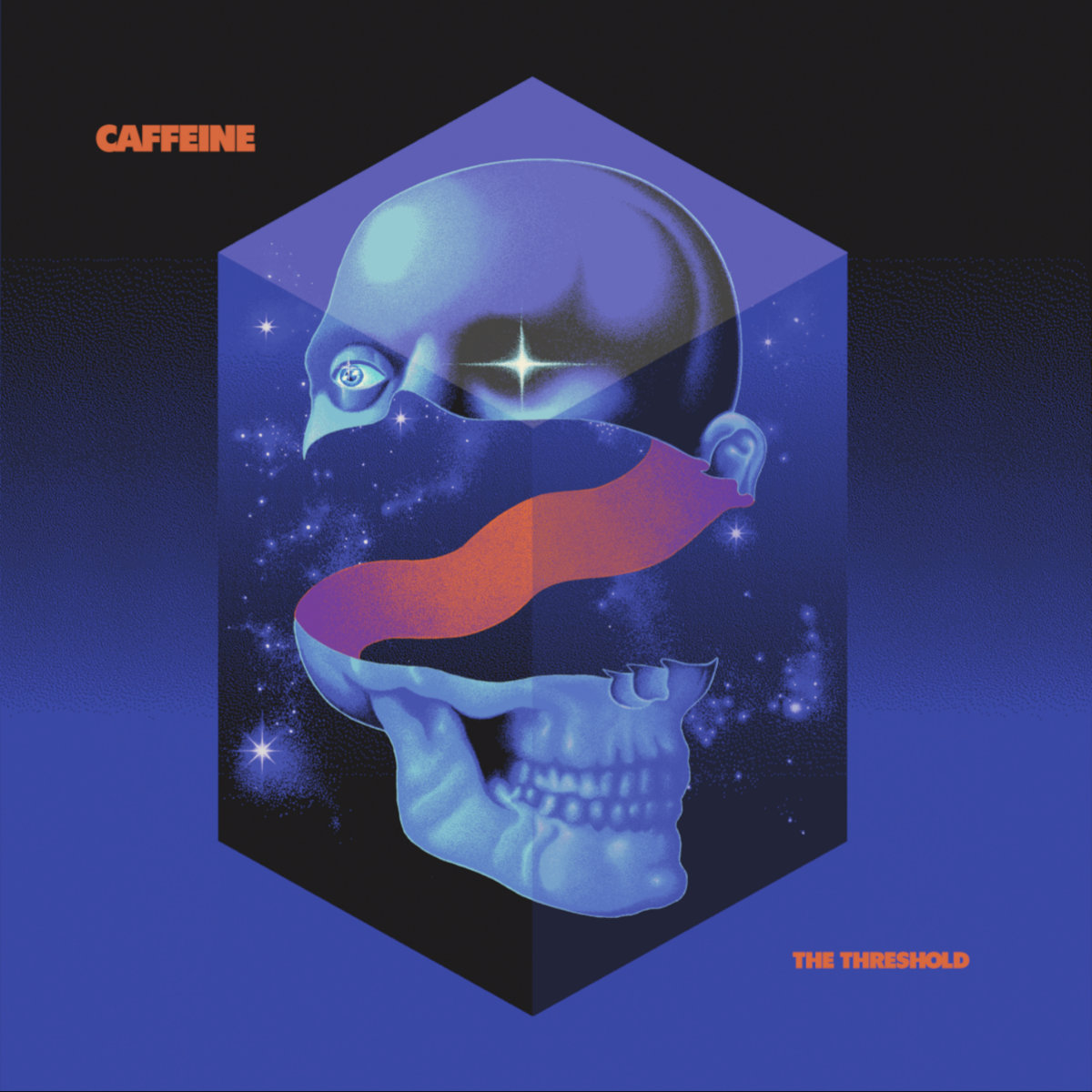
Maybe it shouldn’t be a surprise that Caffeine‘s The Threshold feels so tense and taut since it executes its eight songs in 29 minutes — 10 of which are dedicated to “Ghost Town” and “The Agency” on side B — but as its two sides play out, the Hanover, Germany-based trio of vocalist/bassist Denis Radoncic, guitarist Andre Werk and drummer/vocalist Enrico “Rocko” Winkler, plus Sebi on keys and guitar, find a progressive heavy thrust that’s informed by early Mastodon in its crunch and the rearing-up of riffs on “Last Train” and the twisting rhythms of the title-track, but from a post-hardcore rush in “The THreshold” to the humming tones of the penultimate interlude “Citadel” — which has a more percussive counterpart in side A’s “Rorschach’s Waltz” to the pro-shop heavy metal of “Dead End,” Caffeine‘s material sounds thoughtful in its construction without being a gimme in terms of influence or losing itself in the intensity as it unfolds. This is the band’s second record. It’s a fucking beast.
They’re delivered in a deathly rasp, as perhaps it would need to be, before the clean vocals arrive, but the lyrics in “Space is Now Tainted” from The Mountain King‘s 13th album in 10 years, Stoma, are among the most fitting encapsulations of life under apocalypse-capitalism that I’ve seen. The whole song is brilliant, and it’s one of eight on the 48-minute LP, so I’m not trying to neglect anything else, but when I see lines like, “And when the last tree is down/You will climb the bodies of the ones who didn’t drown,” it’s hard not to be taken aback. The later “Dripping Bats” offers thoughts and prayers for the death of god, so the righteousness is by no means isolated as The Mountain King find a version of doom metal the chug of which has learned at least as much from Carcass‘ Heartwork as anything Black Sabbath ever did, and pushes into avant miserablism in “Twomb” or the intermittently volatile/gorgeous “To the Caves!,” which would seem to be the end The Mountain King see for human decline. Back to the caves. At least the end of the world turned up some good art. I wish more bands would dare to have an opinion.
Time will tell how the balance of NWOBHM grandstanding and from-farther-back boogie shakes out in the sound of German newcomers Kant, but for now, it’s an intriguing blend on the Aschaffenburg-based four-piece’s debut album, Paranoia Pilgrimage, and with the backing of Sound of Liberation Records, one might take the cavernous vocals, cultish melodies and declarative guitar work as part of the needed injection of fresh perspectives that the European heavy underground has been receiving the last few years in generational turnover. That is to say, there’s potential in the nuance of a song like “Traitors Lair,” which injects from flute-prog into the proceedings, and even as Kant search for ‘their sound,’ what they’re finding is likewise varied and exciting, if not blindingly original. The sharper corners of “Dark Procession” and the atmospheric depth offered in opener “The Great Serpent” both find an underpinning of darker, more cultish sounds — unsurprisingly, “Occult Worship” bears that out as well — but when the lead cut launches into its solo late in its five-minute going, Kant revel in the freedom of that breakout. Wherever time and their exploration takes them, Paranoia Pilgrimage is the foundation on which they’ll build.
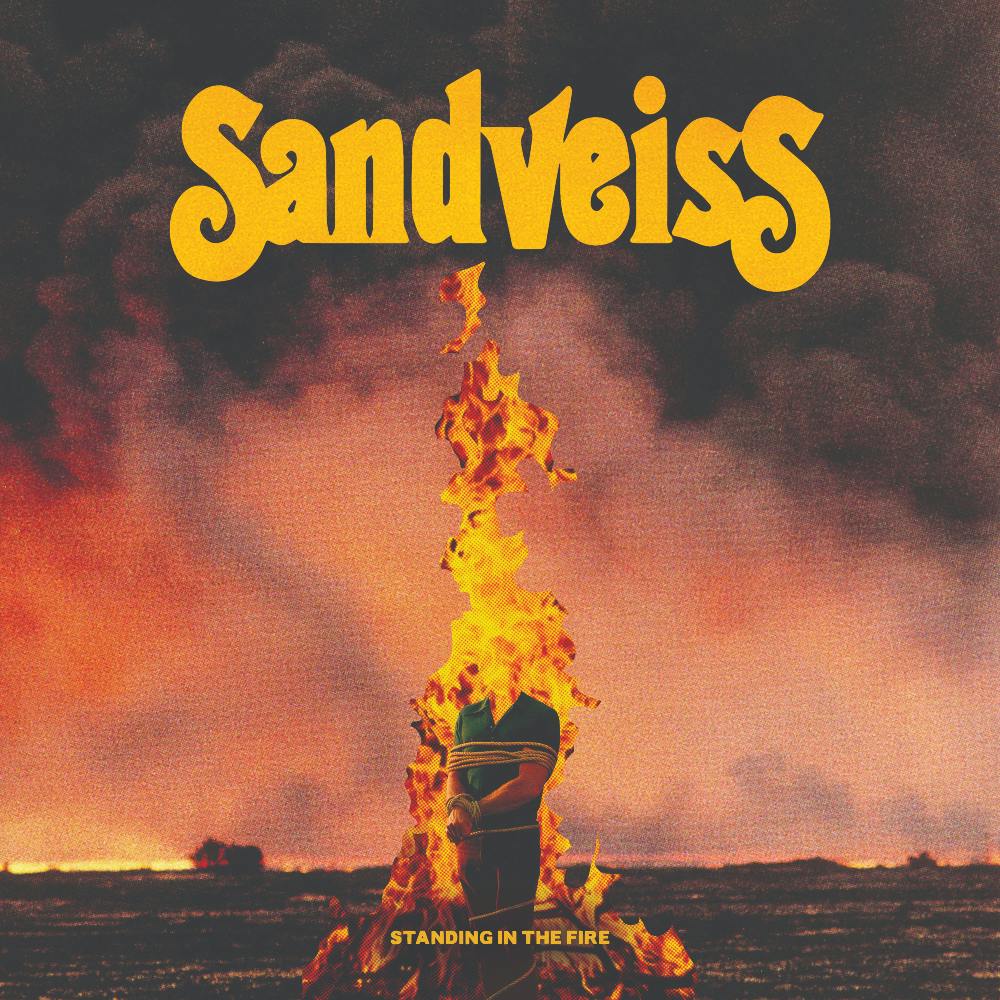
With a mix and master by Karl Daniel Lidén (Katatonia, Dozer, Greenleaf, Vaka, Demon Cleaner, etc.) building on the production helmed by guitarist/vocalist Luc Bourgeois and guitarist Shawn Rice, it’s little wonder Sandveiss‘ third full-length, Standing in the Fire, sounds as full and charged as it does, from the first tones of “I’ll Be Rising” through drummer Dominic Gaumond‘s clinic in “Bleed Me Dry.” Completed by bassist Maxime Moisan, who is the force behind the propulsive “Wait and See” and the later, more expansive “These Cold Hands,” Sandveiss present Standing in the Fire as a showcase of multifaceted songwriting intent. The title-track, opener “I’ll Be Rising,” and the careening “Fade (Into the Night)” are catchy uptempo fuzzers kin to the ethic of Valley of the Sun, but “No Love Here” and the ensuing huge roll of “Bleed Me Dry” bring a stately cast and highlight some of the variety of mood and purpose amid all the heft and professional-grade craft throughout.
If you like your sludge noisy — or your noise sludged — aggressive and pummeling, Plant signal from Madison, Wisconsin, with their first album, Cosmic Phytophthora, a gnashing and duly punishing 44-minute/six-song assault that hits a particularly escape-proof crescendo in side B’s “Envenoming the Carrion” (11:59) and “Skyburial” (11:04) before closing with the harsh tumult of “Wolf Plague.” Once upon a time bands like Axehandle and The Mighty Nimbus walked the earth. Plant would stand well alongside either, with leadoff “Until it Dies” cracking open a can — I’ll assume lime seltzer? — before the drums kick in on what’s basically a spoken-word-topped riff introducing the seethe and tones that define what’s to come, screaming by the time its three minutes are up. “Anthracnos Stalk Rot” and the outright brutality of “Root Worm” follow and underscore the impression of a horticultural thematic, but whether you’re digging on plant parts or reeling from the various punches the band throw along the way, it’s hard not to be moved by a debut that has such a clear idea of what it’s about. Make it loud, make it caustic, make it hurt. Riffs to break oneself upon.
Tommy and the Teleboys, Gods, Used, in Great Condition
There are threads of punk and classic rock running through Tommy and the Teleboys‘ dance-ready debut long-player, Gods, Used in Great Condition, but ultimately the album is neither of them. United under a scope that includes psychedelia, proggy-jazz and maybe a bit of heavy blues, the post-modern nine-song outing has a depth of mix all the more emphasized through the band’s stylistic range, but it’s a feeling of brashness that seems most to bring the songs together and the vital sense of command in the tracks themselves. Each follows its own plot, whether it’s the willfully off-kilter “Loverboy” or textured pieces like “Seninle” and “Srevokk” later on, but “Gib Mir” and “Jesus Crowd” at the start — shades of Bowie Ameriphobia in the latter — give Gods, Used in Great Condition quirk to coincide with all its hey-we’re-not-40-yet urgency, and while the band range hither and yon in terms of style, there’s nowhere the melodic wash of “Jeffrey 3000” or the otherworldly wistful strum of “Night at the Junkyard” go that feels out of place in the surrounding context, and Tommy and the Teleboys seem to be serving notice to anyone clued in of intention to disrupt. One hopes they do.
MEDB is a new solo-project by Rodger Boyle, who also runs Cursed Monk Records and features in bands like Noosed, ÚATH and Stonecarver, among others, and this first demo unveils four songs working under the stated concept of conveying the landscape/ambience of Boyle‘s home in Waterford, Ireland. Certainly the ambience of “Returning Home” is darker than the photos from the Port Láirge tourism committee, but while MEDB lays claim to a drumless drone on that nine-and-a-half-minute opener, “Glasha,” “Mahon Falls” and “The Wild Deer of Sillaheen” conjure a more full-band impression, plodding in “Glasha” before “Mahon Falls” digs into a more open and meditative feel in one guitar layer while lower distortion holds sway beneath, and “The Wild Deer of Sillaheen” earns its post-metallic antlers at the finish. So you’re saying there’s more than one thing going on in Waterford? Reasonable to expect for the oldest city in the Republic of Ireland, and all the better for inspiring future manifestation from MEDB, whatever form that might take. You could do worse than learning about a place through audio.
[Press play above to stream Ruff Majik’s Moth Eater in its entirety. Album is out tomorrow, Oct. 4, through SOL Records. The band are currently on tour in Europe with Gnome. Dates are here.]
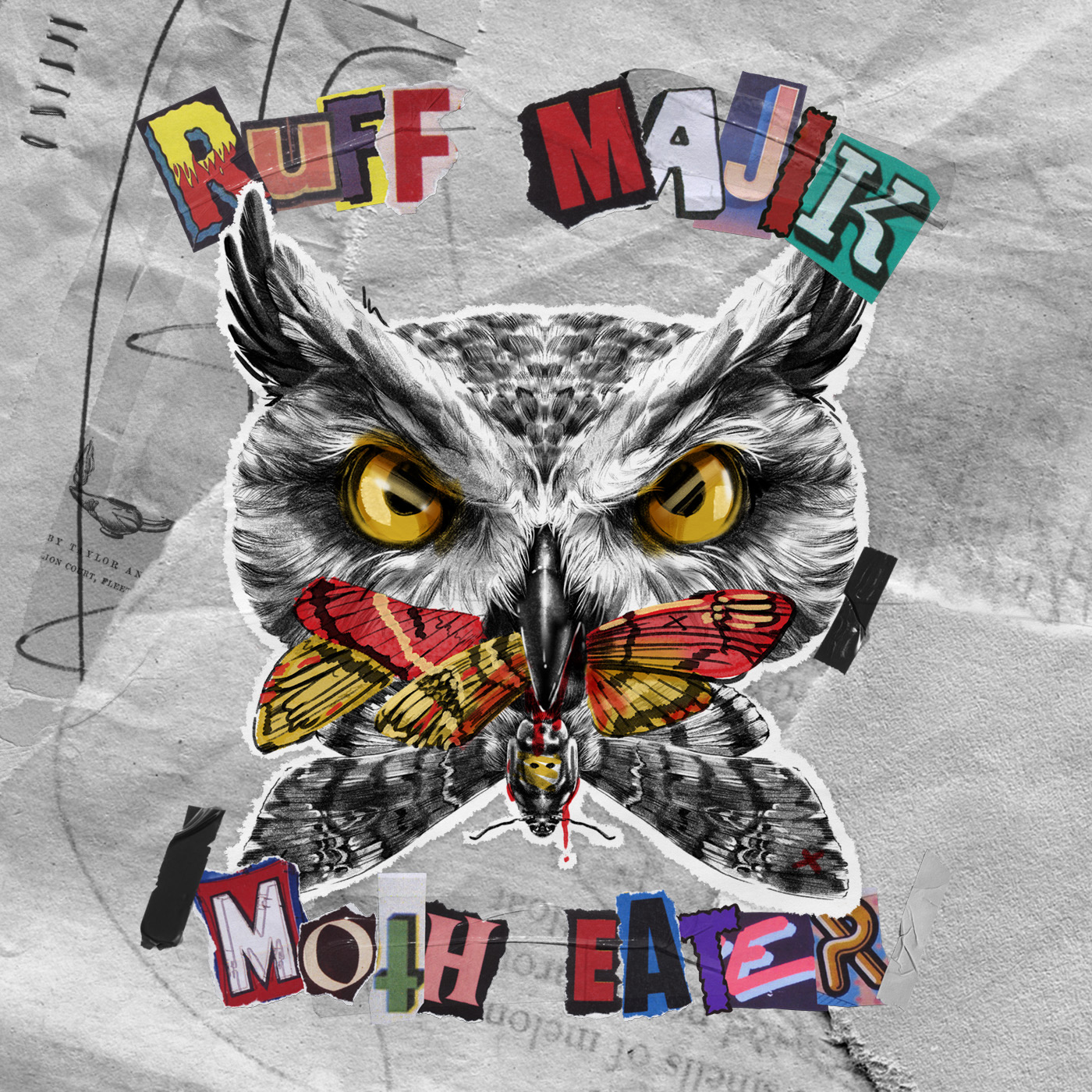
Hail narrative, and double-hail the wielding of it. Ruff Majik‘s fifth album in six years, Moth Eater is also their first for the Sound of Liberation label arm SOL Records and it finds the South African four-piece — vocalist/guitarist Johni Holiday, guitarist/vocalist Cowboy Bez, bassist Jimmy Glass and drummer Steven “Boz Moon” Bosman — with grueling tales of underground debauchery, trials and triumphs, set to dizzying instrumentalist turns and full-rush party-vibe conjurations. To aid in the telling are guests like South Africa’s Reegan Du Buisson (Evergloom, Facing the Gallows) on opener “What a Time to Be a Knife,” and Lerato, who appears on the side B funk-fortified groover “Ingozi” (the Zulu word for “danger” as the lyric sheet notes), and Sweden’s Arvid Hällagård (Greenleaf, Young Acid, Pools), and an overarching structure that brings the sometimes disparate tracks together with transitional recordings of voicemails that are mostly funny and no doubt have their foundations in stories too.
Because make no mistake, even though the songs are short, shove-prone, and fun, what’s happening on Moth Eater — which is not-coincidentally subtitled ‘The Lorekeeper’s Bible’ — is nothing less than Ruff Majik realizing the power of and taking control of their narrative. “Dirt and Deer Blood?” Oh that’s a story. The angry voicemail before the drums start opener “What a Time to Be a Knife” that ends with the threat, “I’ll make sure you never play another show in this town, bru!” as if the band’s intentions were so limited to a single city? That’s a story too. “Wasted Youth?” Come on. That’s a drinking song. Of course it’s a story.
You get the idea. The story is story. This is consistent in some ways with the last two, also stellar, Ruff Majik full-lengths, 2020’s The Devil’s Cattle (review here), where they learned genre was a tool to be manipulated, and more especially 2023’s Elektrik Ram (review here), with which much of Moth Eater is in conversation, sometimes directly, as in the voicemail from the CEO of Riffcom as played by Paul Gioia (All This for Nothing), who congratulates ‘Wilkinson’ on a job well done after the brainmelting percussive thrust of early cut “By the Hammer,” following up on a similarly charming gag from the last record, and sometimes indirectly, as in the way “What a Time to Be a Knife” middle-fingers-up rages in the spirit of Elektrik Ram‘s opener “Hillbilly Fight Song” or “All You Need is Speed” from The Devil’s Cattle, or even the fact that the last line of the closing title-track on Moth Eater is “I feel fine,” where Elektrik Ram wrapped with, “I wish I was dead.”
That that choice feels purposeful at all — and it does — is emblematic of Ruff Majik‘s attention to detail, but one doesn’t have to dig even so far to find that. It’s audible in the multi-layered vocal arrangements throughout, with Holiday‘s voice pushed low on “We’re Not Out of the Swamp Yet” and at its most Axl Rose-esque in “Wasted Youth,” or instrumentally, in the way Glass‘ bassline matches the vocal thoughtfully in the otherwise frenetic “By the Hammer” — which is so much of a story it’s mythology — for the lines, “Oh, and the blood it would stain her pretty white dress/Oh, if Odin wills, she’ll have their heads,” or the manner in which “Cult Eyes” finds itself in a mid-tempo bluesy swagger so suited to the Holiday/Hällagård duet that tops it, or how “Baby’s First Guillotine” moves from its perhaps ill-advised opening voicemail — a German-accented guy talking in a lisped voice about the band shaking their asses resolving in the punchline, “that’s what’s fappening”; I’m sure there’s a story there, too, but it could be taken as a little ha-ha-queerness-is-funny-because-it’s-different-from-me in a way that’s probably more sixth-grade than the band intended — into self-titled-era Alice in Chains-style pulls of guitar in its tension-releasing chorus.
Such persistent self-awareness and generally intelligent structured craft and lyrics are not anchors holding the band back. Instead, as much as it’s a party on the surface, depth abounds in a lyrical reference like “I’m killing snakes/Call me Patrick” in “What a Time to Be a Knife” — subtly namedropping the patron saint of Ireland — and the last lyrics, “Oh Mary, you should’ve seen me in my prime/I could’ve made it, I just didn’t have the time” from the maddeningly catchy “Battering Lamb,” which is a highlight examining the life of a band trying to exist in the current underground sphere, its own chorus, “And I’ve won some/But I’ve lost some too/I’ve been told it’s all part of the game/And I’ve burned through/A stack or two/I’ve been told money ain’t no thang,” encapsulating the experience from inside a nebulous idea of what ‘making it’ means in the first place when the rewards are often intangible at best. That the voicemail accompanying “Battering Lam” at the start and finish is a desperate fan who “needs the fuzz in my life” and “needs some Majik” as though addicted to it should not be taken as a coincidence. Clearly among the things Ruff Majik know about themselves is they know when they’re on fire.
Much of Moth Eater is spent in that very state. To wit, as “Dirt and Deer Blood” shifts from its opening sample of a longwinded tour manager/driver into its verse, Ruff Majik have by then amassed enough capital in attitude to sell the bridge lines, “Y’all don’t even know who the fuck I think I am,” and “Y’all keep playing preacher and I’ll keep getting lit,” without sounding ridiculous. No minor accomplishment, and the song itself is likewise a burner. Sound of Liberation‘s Matte Vandeven (also My Sleeping Karma and The Great Escape) offers some noncommittal compliments after “Baby’s First Guillotine,” and the joke is that the band are killing it. Broadly speaking, the songs don’t make efficiency the top priority in a way that Elektrik Ram often did, and that’s something you can hear even when “What a Time to Be a Knife” kicks back in after a stop that, on the record before, would’ve just been its cold ending. The tradeoff for that immediacy is the material here does more. In that song, for example, the final section rides a more open groove and turns well-timed repetitions of “Get fucked!” into a memorable impression that defines in part the point of view of everything that follows. It enhances the story Ruff Majik are telling, and story is the priority.
A singalong finish for “Wasted Youth” — “Now all I’ve got left is wasted youth/And all I have is half of the truth/I said I never felt lonely/Until I met you/Until I met you…” — gives over (without a sample between) to the title-track, which establishes acoustic guitar early and trades off into a fervent push echoing “By the Hammer” as much as the quieter parts and lyrics complement Elektrik Ram‘s previously-alluded-to “Chemically Humanized.” Decidedly, willfully more lighthearted, “Moth Eater” caps the LP that shares its name with the punchline for all the voicemails spread across its span with a simple deleting of messages. It’s a little awkward after the very-much-an-ending way “Moth Eater” rounds out, but if they were going to conclude that thread at all — and they were, because storytelling — that’s a fair enough way to do it, reinforcing the attitude underlying the songs front-to-back and underscoring the band’s intention to do their own thing in their own way, even if it means they’ll never get another show in this town again, whatever town this may be.
There is a particular element of glee as Ruff Majik dash from part to part, righteous in their us-against-reality cause and assured by a strength of songwriting that makes the song likewise casual-cool and roilingly infectious, and if Elektrik Ram was staring into the abyss, Moth Eater is perhaps throwing the abyss in the van and hitting the road alongside it in buddy-comedy fashion. It is undeniably Ruff Majik‘s own in persona and execution, and even if the trilogy that began in The Devil’s Cattle is done — which it may or may not be — the band thankfully show no signs of letting up anytime soon. May their next round of adventures also result in such a broad swath of stories recounted.
Posted in Whathaveyou on September 11th, 2024 by JJ Koczan
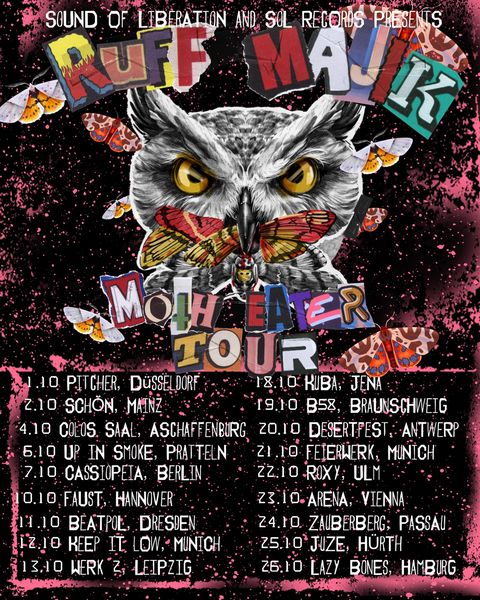
South African four-piece Ruff Maijk will return to Europe for a fest-anchored run of mostly German dates starting Oct. 1. Their new album, Moth Eater, is out three days later through the booking agency Sound of Liberation‘s label wing, SOL Records. That Aschaffenburg show is sure to be a party, though I suppose you could say that for the rest as well. At the end of last week, the band put up the new single “Wasted Youth” showing off some of the more complex melody and emotionalism present throughout the album while reassuring that the hooks, the groove and the fun are maintained. I’m not surprised that I dig the record, but it’s a different animal than the genre-crossing mania of last year’s Elektrik Ram (review here), which seemed to thrive balanced on a tightrope of craft. Moth Eater digs a little deeper into each song, pushing forward in terms of style without wanting to convey the same kind of urgency, panic, call it what you will.
I was lucky to see Ruff Majik play live for Elektrik Ram. I don’t think an invite to Desertfest Belgium or any of the other fests listed below is coming, so I’ll likely not catch them on this run, but I do await the day they announce a US incursion. In years past, I’d have speculated Psycho Las Vegas to host such a thing, and certainly Planet Desert Rock Weekend in the same city (at a much different scale) has its ethic of importing quality bands as well, but if it were to happen at Desertfest New York next year, I most certainly wouldn’t complain about that. I’ll keep my fingers crossed, which, yes, will make it harder to type.
As regards Moth Eater, mark your calendar for Oct. 3 as I’ll be streaming the record in full with a review a day ahead of its proper release. Get stoked. I am.
Tour dates follow, as posted by Sound of Liberation on the old social medias:
Europe, your boys are coming back ❤️
This October, @soundofliberation and @soundofliberationrecords presents @ruffmajik 7th European tour, which will include sets at @desertfest_belgium @up_in_smoke_festival @keep_it_low_festival , Lazy Bones festival and many more!
In support of the new album “Moth Eater”, the boys will also be joining @gnomeverse and @templefang on the road for select dates.
More dates are also being actively added, so if you don’t see your town on the list, get in touch.
RUFF MAJIK – Moth Eater European Tour: 01.10 Pitcher Düsseldorf DE 02.10 Schön Mainz DE 04.10 Colos Saal Aschaffenburg DE 06.10 Up in Smoke Festival Pratteln CH 07.10 Cassiopeia Berlin DE 10.10 Faust Hannover DE 11.10 Beatpol Dresden DE 12.10 Keep it Low Festival Munich DE 13.10 Werk 2 Leipzig DE 18.10 Kuba Jena DE 19.10 B58 Braunschweig DE 20.20 Desertfest Antwerp BE 21.10 Feierwerk Munich DE 22.10 Roxy Ulm DE 23.10 Arena Wien AT 24.10 Zauberberg Passau DE 25.10 Juze Hürth DE 26.10 Lazy Bones Festival Hamburg DE
Posted in Whathaveyou on August 5th, 2024 by JJ Koczan
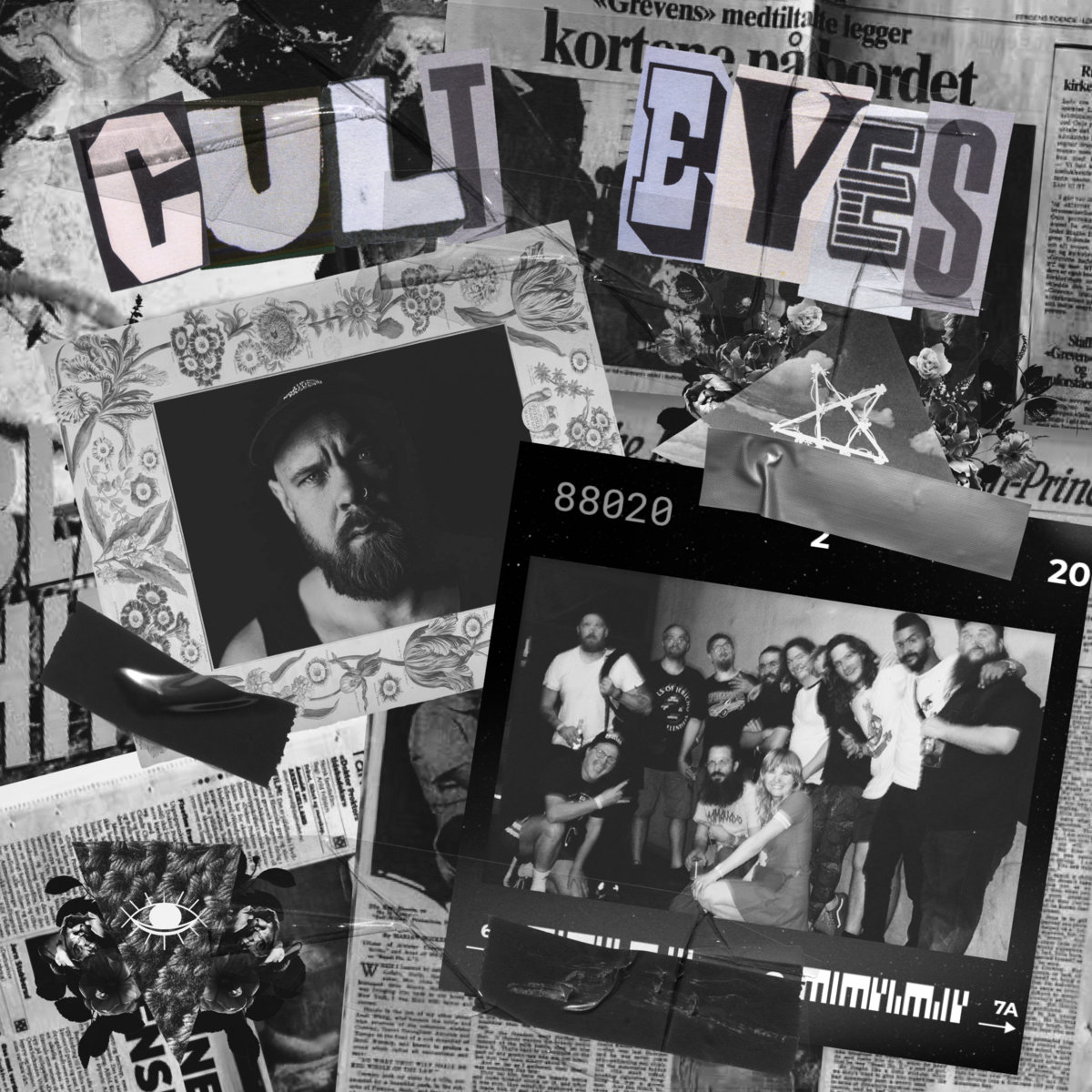
Behold the third single from the upcoming Ruff Majik LP, Moth Eater. “Cult Eyes” is notable both for its divergence from the band’s stare-into-the-mania-and-the-mania-stands-back methodology and the guest vocal spot from Greenleaf‘s Arvid Hällagård (also Young Acid, Sleep Moscow, Pools, etc.), but the twist is well-placed amid the many voicemails and turns throughout Moth Eater, and it’s all part of the narrative assertion being made across the record — that is, Ruff Majik taking control of their own story and how it’s presented — and so consistent in making its own kind of sense.
Indeed, a big part of that the South African four-piece are doing with Moth Eater is storytelling, and you can get a sliver of that through the quote below, but that’s just a sample for one song. The whole album has tales for context and even as they seem to advocate turning away from a social-algorith-driven content-provider ethic, they’ve got more to say to their audience than ever. I’m still getting to know the album and still doing some mental ironing on these ideas, so expect more to come as we get closer to the Oct. 4 (originally listed as Sept. 27) release. I haven’t put in a request to stream the album yet, but I should probably get on that.
While I do, here’s PR wire info and the clip for “Cult Eyes.” As always, I hope you enjoy:
South African Fuzz Rockers RUFF MAJIK Release New Video Single “Cult Eyes”, Feat. Arvid Hällagård Of GREENLEAF, Taken From Upcoming Studio Album “Moth Eater”!
October 4, 2024 will see South Africa’s megalithic Ruff Majik release their brand new studio offering, entitled Moth Eater via SOL Records, the label imprint run by Sound Of Liberation (Desertfest Berlin, Keep It Low, Up In Smoke etc. and booking agency for numerous, high-class artists of the stoner, psych, rock and doom metal / sludge scene). Visit the SOL Records Shop at: https://shop.soundofliberation.com
Following previously-released singles such as “What A Time To Be A Knife”, today, Ruff Majik have unleashed a video clip for the song “Cult Eyes”, featuring a guest vocal performance of GREENLEAF frontman Arvid Hällagård! Get the song, out now on all digital streaming providers, at: https://orcd.co/culteyes
“The lyrics for Cult Eyes came about when we became aware of the fact that we had inadvertently started an actual cult based around our music (Yes, the cult is VERY real. No, we won’t tell you where it is or how it started).” The band comments.
“It’s mostly about nonchalantly accepting the role as a cult figure, and then realizing the weight and impact your actions have on your followers, and specifically having to be accountable for those actions. Of course the protagonist in the song doesn’t want to accept any of his own mistakes or take control of anything, just like cult leaders usually don’t, and this selfishness results in death and ruin. It can also be interpreted as an allegory for the modern state of politics and social media influence, where cult leaders spew out nonsense with no accountability.
Arvid Hällagård of Greenleaf tracked vocal harmonies for the song back in 2021, but due to an unfortunate sabotage, the original track was lost to the ether. When Greenleaf and Ruff Majik played together in 2023, the bands got to talking, and Tommi Holappa brought up the fact that Greenleaf listens to a lot of Ruff Majik in the tour van. Arvid and Johni spoke about the sadly lost song, and the decision was made to redo it. It’s a bit of a “what the fuck?” moment for us, since we’ve idolized Greenleaf for years – and Johni even tried to hoodwink them into touring with us before anyone ever heard about us. So, a full circle moment indeed.”
Kicking the vibe back to a sepia-toned era where bell-bottoms and fuzzed-out bass were de rigueur, the ‘Majik lads take a well-known template and drench it with their unique attitude and stoner-esque sensibilities. The horned infant known as Ruff Majik emerged from the primordial ooze when the band moved from the historical town of Lydenburg in 2012 to the capital city of Pretoria, where they honed their craft for a few years before finally entering the studio to record for the first time. In 2024 and while they are currently gearing up for the October-release of their Moth Eater on Sound Of Liberation Records, Ruff Majik released a number of EP’s and three lauded albums to date, not to mention the megaton of local and international touring (watch out for new tour dates, to be announced for October 2024 soon)!
All the requisite ‘Majik trope boxes are ticked in thick, bold permanent marker – sludgy, distorted riffs, vast landscapes of sonic abandon, dark imagery that perfectly complements the delicious cacophony, and tasty sound bites that add infinite swathes of colour. This is what is expected from the band, their signature sound and one that never fails.
Album Tracklist: 01. What A Time To Be A Knife 02. Dirt And Deer Blood 03. By The Hammer 04. We’re Not Out Of The Swamp Yet 05. Battering Lamb 06. Cult Eyes 07. Baby’s First Guillotine 08. Ingozi 09. Wasted Youth 10. Moth Eater
Ruff Majik are: Johni Holiday (vocals & guitar) Cowboy Bez (guitar & vocals) Jimmy Glass (bass) Steven Bosman (drums)

 blows it out, while side B expands around what the band has by-then established as the album’s intention. “Good Faith” is a consuming plunge still relatively clearheaded in a way that emphasizes the producer’s ear involved in this self-production as regards both the efficiency and professionalism of the presentation and the passion behind the execution of the songs, and the subsequent “Crux” is a sub-three-minute tempo kick with a crunchier fuzz in the guitar and an urgency that, again, hits at just the right time in the tracklisting.